Vietnam Steel 2026: 6 Survival Pressures & Cost Optimization
It's 3 AM. You're a steel mill owner in Bình Dương province, staring at your phone. The latest electricity bill shows another 4.2% increase — the fourth hike since 2023. Your EU export orders have dropped 27% this year. And tomorrow morning, your compliance team needs answers about something called "CBAM carbon certificates" that could add €60-100 to every tonne of steel you ship to Europe.
This isn't a future scenario. This is Vietnam's steel industry in 2026.
The Vietnamese steel sector faces not one, not two, but six simultaneous survival pressures that are already reshaping who wins and who disappears. The mills that recognize these pressures as catalysts — not just threats — will capture the competitive advantages that slower rivals leave on the table.
This article breaks down each pressure with hard data, explains why the window for action is closing, and shows how early movers are already turning crisis into cost leadership.
Strategy Deep-Dive: How can small & medium steel mills compete against giants like Hoa Phat? Read our newly released guide: How Small & Medium Vietnam Steel Mills Can Combat Hoa Phat's Self-Generation Advantage →
At a Glance: The Six Pressures
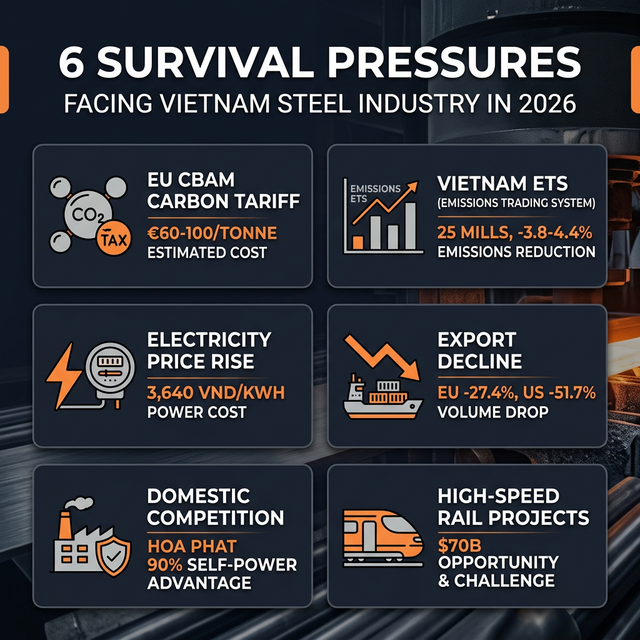
| # | Pressure | Key Data Point | Impact Level |
|---|---|---|---|
| 1 | EU CBAM Carbon Tariff | Effective Jan 1, 2026 | 🔴 Critical |
| 2 | Vietnam ETS Pilot | 25 mills enrolled, quotas shrinking 3.8-4.4% | 🔴 Critical |
| 3 | Electricity Price Hikes | Peak rate: 3,640 VND/kWh (4th increase) | 🟠 High |
| 4 | Export Market Collapse | EU -27.4%, US -51.7% | 🟠 High |
| 5 | Domestic Competition | Hoa Phat saves $133M/year via self-generation | 🔴 Critical |
| 6 | $70B High-Speed Rail | 2026.12 target groundbreaking | 🟡 Opportunity |
Figure 1: The six simultaneous survival pressures reshaping Vietnam's steel industry in 2026
1. EU CBAM Carbon Tariff: The €60-100/Tonne Shock (Effective January 1, 2026)
The EU Carbon Border Adjustment Mechanism has moved from transitional reporting to full financial enforcement. Vietnamese steel exported to the European Union now requires purchasing carbon certificates matching the embedded CO₂ emissions of each shipment.
Why is CBAM a bigger threat to Vietnamese steel mills than to Chinese competitors?
Chinese steel producers have operated under a national Emissions Trading System since 2021. They've spent five years building carbon measurement infrastructure, training compliance teams, and internalizing carbon costs into their pricing models. Vietnamese mills are encountering mandatory carbon accounting for the first time — without the institutional experience, the measurement tools, or the export margin buffer to absorb these new costs.
The math is straightforward and painful:
- Average carbon intensity of Vietnamese steel: ~1.8-2.2 tonnes CO₂ per tonne of steel
- EU carbon price (2026 projection): €60-100 per tonne CO₂
- Additional cost per tonne of steel exported to EU: €108-220
- Current export margin for many Vietnamese mills: <€50/tonne
For a mid-sized mill exporting 50,000 tonnes annually to the EU, CBAM compliance could mean an additional $6-12 million per year in carbon certificate costs — if they can even calculate their emissions accurately enough to file reports.
"CBAM is not a cost curse — it's an efficiency filter. The mills that achieve precise carbon measurement first will gain pricing power in the EU market, while competitors scramble to even file compliant reports." — Dr. Chen Wei, Chief Thermal Engineer, South Technology
The critical gap isn't just cost — it's measurement capability. Most Vietnamese mills today estimate their emissions using industry averages. CBAM regulations require facility-specific, verified emissions data. Mills that cannot provide this face default values that assume worst-case carbon intensity — dramatically inflating their certificate costs.
How can a steel mill quickly build CBAM-compliant carbon measurement?
The fastest path is deploying AI-driven combustion control systems that monitor fuel consumption, air-fuel ratios, and flue gas composition in real-time across every burner zone. These systems generate the granular, verifiable emissions data that CBAM compliance demands — while simultaneously reducing the emissions themselves by 7-15% through optimized combustion efficiency.
Related Analysis: What is the detailed timeline and carbon certificate pricing projection for Vietnam? Check out our: Vietnam Steel Industry Outlook 2026: CBAM Compliance Roadmap & Quota Pricing →
2. Vietnam ETS Pilot: 25 Mills Enrolled, Quotas Already Shrinking
Vietnam's domestic Emissions Trading System launched its pilot phase in June 2025, enrolling 25 major steel producers. This isn't a distant policy discussion — it's an operational reality with financial consequences that compound each year.
According to the International Carbon Action Partnership (ICAP), the pilot program mandates:
- Annual quota reduction: 3.8-4.4% per year through 2030
- Mandatory reporting: Real-time emissions monitoring for enrolled facilities
- Carbon credit trading: Expected to launch in 2027 with initial prices of $8-15/tonne CO₂
The compounding effect is what most mill owners underestimate. A 4% annual reduction doesn't sound dramatic — until you calculate that by 2030, your allowed emissions will be 20-25% below your 2025 baseline. For a mill currently running near capacity with legacy combustion systems, this means either:
- Invest in efficiency to reduce emissions within your shrinking quota, or
- Purchase carbon credits at prices that will only increase as supply tightens
"The ETS pilot is Vietnam's signal to the world — and to its own industry — that carbon has a price. The 25 enrolled mills are the canaries in the coal mine. Within 3 years, every steel producer in Vietnam will face the same regime." — Zhang Liang, Senior Process Engineer, South Technology
What happens if a mill exceeds its ETS quota?
Under the pilot framework, excess emissions must be covered by purchasing carbon credits from the market or through certified emission reduction projects. Mills that proactively reduce emissions below their quota can sell surplus credits — turning compliance from a cost center into a potential revenue stream. AI-powered combustion optimization provides the verified emission reduction data needed to generate tradeable carbon credits.
3. Electricity Price Escalation: The Fourth Hike Hits Furnace Economics
Vietnam industrial electricity prices have risen four times since 2023, with peak-hour rates now reaching 3,640 VND/kWh — a level that fundamentally changes the economics of steel reheating operations.
For steel reheating furnaces, electricity costs drive fans, conveyors, cooling systems, and increasingly, auxiliary heating elements. While natural gas remains the primary fuel, electricity typically accounts for 15-25% of total furnace operating costs.
Peak vs. Off-Peak: The 3.3x Gap
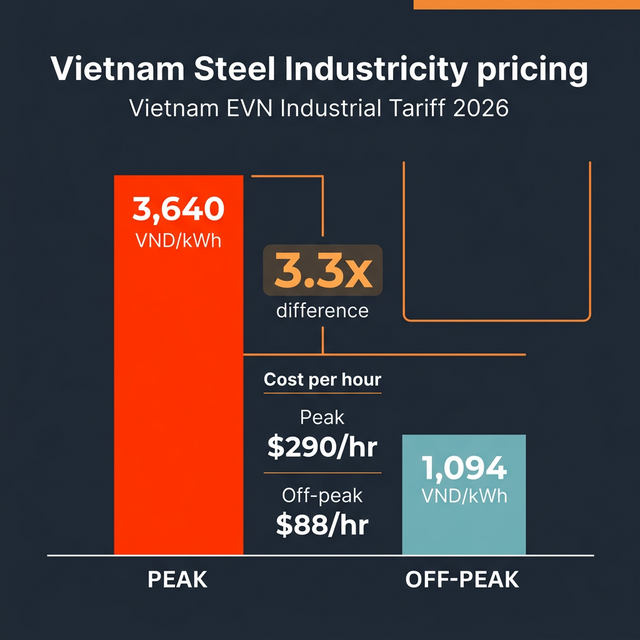 Figure 2: The 3.3x gap between peak and off-peak electricity rates fundamentally changes reheating furnace economics
| Time Period | Rate (VND/kWh) | Rate (USD/kWh) | Cost Impact |
|---|---|---|---|
| Peak hours (9:30-11:30, 17:00-20:00) | 3,640 | ~$0.145 | Highest cost window |
| Standard hours | 2,461 | ~$0.098 | Baseline operations |
| Off-peak hours (22:00-4:00) | 1,094 | ~$0.044 | Lowest cost window |
| Peak/Off-peak ratio | 3.3x | — | Critical scheduling factor |
Source: Vietnam Electricity (EVN) industrial tariff schedule
The 3.3x differential between peak and off-peak rates means that a furnace consuming 2 MW during peak hours costs $290/hour versus $88/hour off-peak. For mills running 24/7, intelligent load shifting — powered by AI production scheduling — can reduce annual electricity costs by $200,000-500,000 without any hardware changes.
How does smart load management reduce electricity costs in steel reheating?
AI-driven thermal management systems predict furnace heat requirements 2-4 hours in advance based on rolling mill schedules, billet inventory, and ambient conditions. By pre-heating billets during off-peak hours and maintaining optimal thermal mass during peak periods, mills can shift 15-30% of their electricity consumption to lower-rate time windows while maintaining production throughput.
"Every steel mill owner knows peak electricity is expensive. What most don't realize is that their reheating furnace is the single largest controllable electricity load in the plant. Smart thermal management isn't just about gas — it's about scheduling every kilowatt-hour to the cheapest window possible." — Dr. Chen Wei, Chief Thermal Engineer, South Technology
4. Export Market Collapse: EU -27.4%, US -51.7%
Vietnam's steel export volumes to its two largest Western markets have cratered. According to the Vietnam Steel Association (VSA), 2025 export data shows:
- EU exports: Down 27.4% year-over-year
- US exports: Down 51.7% year-over-year
The causes are a convergence of anti-dumping duties, trade barriers, and CBAM pre-compliance pressure that collectively make Vietnamese steel uncompetitive in premium export markets.
The US has imposed anti-dumping duties ranging from 25% to over 200% on various Vietnamese steel products, while the EU's CBAM transitional phase has already caused European buyers to shift sourcing toward suppliers who can provide verified low-carbon steel.
The domestic market trap: As export channels narrow, Vietnamese mills are flooding the domestic market with surplus capacity. The result is a price war that has compressed margins to razor-thin levels — or into outright losses.
The case studies are sobering:
| Company | 2025 Financial Result | Status |
|---|---|---|
| Pomina Steel | Loss of $32.28 million | Near bankruptcy, debt restructuring |
| Hoa Sen Group | Profit decline -62.3% | Severe margin compression |
| Multiple small mills | Operating at 40-60% capacity | Survival mode |
The mills that survive this export contraction will be those that achieve the lowest per-tonne production costs — and the reheating furnace is where the largest controllable cost savings exist. A 7-15% reduction in fuel consumption through T80-certified optimization technologies translates directly to survival margin in a price-war environment.
Free B2B Resource
|🔥 Only 12 Spots Left
EcoReheating CBAM Compliance Roadmap for Vietnamese Steel Enterprises
We've compiled a complete, actionable compliance roadmap for Vietnamese steel mills facing EU CBAM carbon tariffs and local ETS pilot requirements. Download the bundle to receive:
CBAM Certificate Templates
Pre-configured sheets to calculate embedded CO₂ intensity.
ETS Quota Trading Strategies
Maximize revenue by selling surplus carbon allocations.
6-Step Export Plan
Actionable checklist for compliance directors to maintain Western access.
Fuel Reduction Calculator
Quickly estimate your potential savings under T80 standards.
This resource is free for steel manufacturing executives and energy engineers. Delivered instantly via email.
5. Domestic Competition: The Hoa Phat Fortress Effect
Hoa Phat Group, Vietnam's largest steel producer, has built a competitive moat that most small and mid-sized mills cannot replicate. The core of this advantage is simple: 90% self-generated power.
By operating its own power plants, Hoa Phat has effectively insulated itself from EVN's electricity price hikes. The annual savings are staggering — approximately $133 million per year in reduced electricity costs compared to mills purchasing from the grid.
Hoa Phat vs. Small-Medium Mills: The Cost Chasm
| Factor | Hoa Phat (Giant) | Small-Medium Mills |
|---|---|---|
| Self-generated power | 90% | 0-10% |
| Annual electricity savings | ~$133 million | None |
| Electricity as % of operating cost | 8-12% | 15-25% |
| CBAM compliance readiness | Dedicated carbon accounting team | No systematic preparation |
| Price competition stance | Price maker | Price taker |
| Production capacity utilization | >85% | 40-60% |
The gap is not just financial — it's structural. Small mills cannot build their own power plants. They cannot achieve Hoa Phat's economies of scale. And in a domestic price war triggered by export collapse, they are fighting with one hand tied behind their back.
But here's what small mills CAN do: They can optimize what they already have.
A reheating furnace consuming 15% more fuel than necessary is not a scale problem — it's an efficiency problem. Whether modernizing legacy pushers into a modern walking beam reheating furnace or deploying modular fiber roofs via turnkey zero-capex furnace revamping solutions, upgrading your thermal balance restores competitive cost parity.
Technical Guide: How do you audit heat loss and gas waste in legacy reheating furnaces? Read our step-by-step checklist: Preventing Downtime: Auditing Heat Loss in Legacy Reheating Furnaces →
Online Tool: Evaluate your mill's stack and wall losses instantly: Run Reheating Furnace Heat Balance Calculator →
"Traditional PLC combustion systems are silently eating 5% of your profit margin. AI predictive control can eliminate this loss completely — and you don't need a billion-dollar balance sheet to deploy it." — Zhang Liang, Senior Process Engineer, South Technology
Through the Energy Steward model, even the smallest mill can access T80-certified optimization technology with zero upfront investment. The playing field may not be level, but the gap can be narrowed significantly.
Challenge Hoa Phat's Cost Advantage (Zero Upfront CAPEX)
You don't need a billion-dollar budget to reduce fuel costs. With our Energy Steward Model, we install T80-certified AI optimizations at zero upfront cost, sharing the verified fuel savings.
Get Free ROI Audit →
Can small steel mills really compete with Hoa Phat after electricity prices rise?
Not on electricity costs alone — that battle is lost. But small mills can compete on fuel efficiency, product specialization, and operational agility. A mid-sized mill achieving 7-15% fuel savings through AI combustion optimization, combined with reduced scale losses and intelligent scheduling, can reclaim 3-5 percentage points of margin. In specialized product segments (construction steel, wire rod, specialty sections), this margin advantage is often enough to sustain profitable operations. View proven results from similar Vietnamese mills.
6. The $70 Billion High-Speed Rail: Opportunity or Mirage?
Vietnam's North-South high-speed rail project — a 1,541 km corridor with a budget of $68-70 billion — is targeting groundbreaking in December 2026. On paper, this represents the largest infrastructure steel demand in Vietnam's history.
But here's the uncomfortable truth: high-speed rail steel is not commodity rebar.
The quality specifications for high-speed rail components — tracks, structural steel, reinforcement — require:
- Ultra-low sulfur and phosphorus content
- Precise metallurgical composition control
- Full traceability from raw material to finished product
- Carbon footprint documentation (increasingly required for government infrastructure)
Today, only a handful of Vietnamese producers — primarily Hoa Phat — can meet these specifications. For the remaining mills, the high-speed rail project is not an automatic lifeline. It's a qualification challenge that requires both product quality upgrades and energy efficiency improvements.
Why energy efficiency? Because the government's sustainability requirements for major infrastructure projects increasingly include carbon intensity metrics for supplied materials. A mill that cannot demonstrate low-carbon production processes will be excluded from the supply chain, regardless of price.
The path from "interested bidder" to "qualified supplier" runs directly through the reheating furnace — where precise temperature control, reduced oxidation losses, and verified emission reduction create the quality and sustainability credentials that high-speed rail procurement demands.
The Turning Point: From Pressure to Advantage
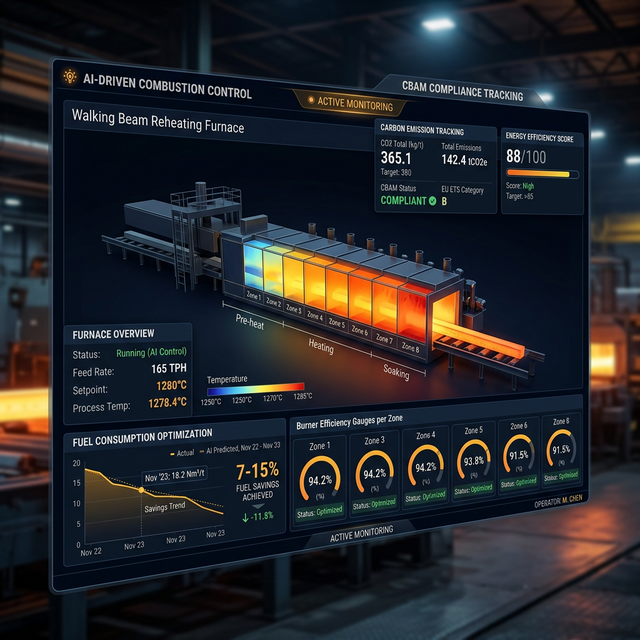 Figure 3: EcoReheating's AI combustion control dashboard — real-time carbon tracking meets furnace optimization
Six pressures. One conclusion.
Not every Vietnamese steel mill will survive the next 3 years. But the mills that act now — while competitors hesitate — will capture disproportionate advantages:
- CBAM-ready mills will maintain EU market access while competitors are locked out
- ETS-optimized mills will sell surplus carbon credits while others buy them
- Energy-efficient mills will maintain margins in price wars that destroy less efficient rivals
- Quality-certified mills will access high-speed rail contracts that others cannot bid on
The common thread across all six pressures is energy efficiency and carbon measurement capability. The reheating furnace — typically consuming 60-70% of a steel mill's total energy — is the highest-leverage intervention point.
"Our partnership with Thắng Lợi Steel in Vietnam proved that the Zero CAPEX model isn't theory — it's a reality that's already delivering results. They achieved 12% gas savings with zero upfront investment, and now they're using our carbon measurement data to prepare their first CBAM compliance report." — Li Minghua, Energy Steward Program Lead, South Technology
Definition
Energy Steward Model
The Energy Steward Model is a Zero CAPEX performance-based partnership pioneered by EcoReheating (South Technology) where the provider invests all hardware, software, and engineering costs at zero upfront expense to the steel mill. Revenue is shared based on verified energy savings measured against an agreed baseline. If there are no savings, there is no payment. This model eliminates CAPEX risk while guaranteeing measurable fuel reduction — proven across 300+ production lines globally.
Why Choose EcoReheating?
Why Choose EcoReheating?
- 🔧 Zero CAPEX: We invest, you save — no upfront cost
- ✅ 300+ production lines optimized (Danieli, Jinnan, Thắng Lợi...)
- 🛡️ Guarantee: No savings = No payment
- 🏅 T80 Technology certified by CISA as "ultra-high efficiency"
- ⏳ Only 2 new projects/month — Register for free assessment →
Limited Opportunity
Get Your Free Furnace Efficiency Assessment
Do you know how much fuel your reheating furnace is wasting right now? In a 30-minute consultation, our chief thermal engineers will calculate your exact energy loss and outline a custom T80-standard roadmap to cut fuel costs by 7-15%.
Zero CAPEX Model
CISA T80 Certified
Only 1 Spot Left This Month
Register for Free Assessment →
We prioritize mills with savings potential exceeding $100,000/year.
Dr. Chen Wei
Chief Thermal Engineer, South Technology
Dr. Chen has over 15 years of experience in industrial furnace optimization, leading energy efficiency upgrades across 300+ production lines globally, including the 12% fuel savings project at Vietnam's Thắng Lợi Steel.
See how much you could save using our Energy Steward Model
Based on typical 11% fuel efficiency optimization.
Get Verified ROI AuditFrequently Asked Questions
Q.Why is CBAM a bigger threat to Vietnamese steel mills than to Chinese competitors?
Chinese steel producers have operated under a domestic carbon market since 2021, internalizing carbon costs into their pricing. Vietnamese mills, facing CBAM for the first time without a mature domestic carbon pricing mechanism, lack the measurement infrastructure and compliance experience needed to accurately report embedded emissions - potentially facing carbon certificate costs of €60-100 per tonne of steel exported to the EU.
Q.How does the Zero CAPEX model work when traditional furnace upgrades require $500,000+ investment?
Under the Energy Steward model, EcoReheating invests all hardware, software, and engineering costs upfront. The steel mill pays only a share of verified energy savings measured against an agreed baseline. If there are no measurable savings, there is no payment - eliminating all financial risk for the mill.
Q.Can small steel mills really compete with Hoa Phat after electricity prices rise?
While small mills cannot replicate Hoa Phat's 90% self-generated power advantage, they can achieve 7-15% fuel savings through AI-driven combustion optimization and T80-certified technologies. This narrows the cost gap enough to survive and thrive in specialized product segments where agility matters more than scale.
Q.How does smart load management reduce electricity costs in steel reheating?
AI-driven thermal management systems predict furnace heat requirements 2-4 hours in advance based on rolling mill schedules, billet inventory, and ambient conditions. By pre-heating billets during off-peak hours and maintaining optimal thermal mass during peak periods, mills can shift 15-30% of their electricity consumption to lower-rate time windows while maintaining production throughput.
Q.How can a steel mill quickly build CBAM-compliant carbon measurement?
The fastest path is deploying AI-driven combustion control systems that monitor fuel consumption, air-fuel ratios, and flue gas composition in real-time across every burner zone. These systems generate the granular, verifiable emissions data that CBAM compliance demands - while simultaneously reducing the emissions themselves by 7-15% through optimized combustion efficiency.
Dr. Chen Wei
Chief Thermal Engineer, South Technology
Dr. Chen has over 15 years of experience in industrial furnace optimization, leading energy efficiency upgrades across 300+ production lines globally, including the 12% fuel savings project at Vietnam's Thắng Lợi Steel.