Reheating Furnace Audit in Indonesia
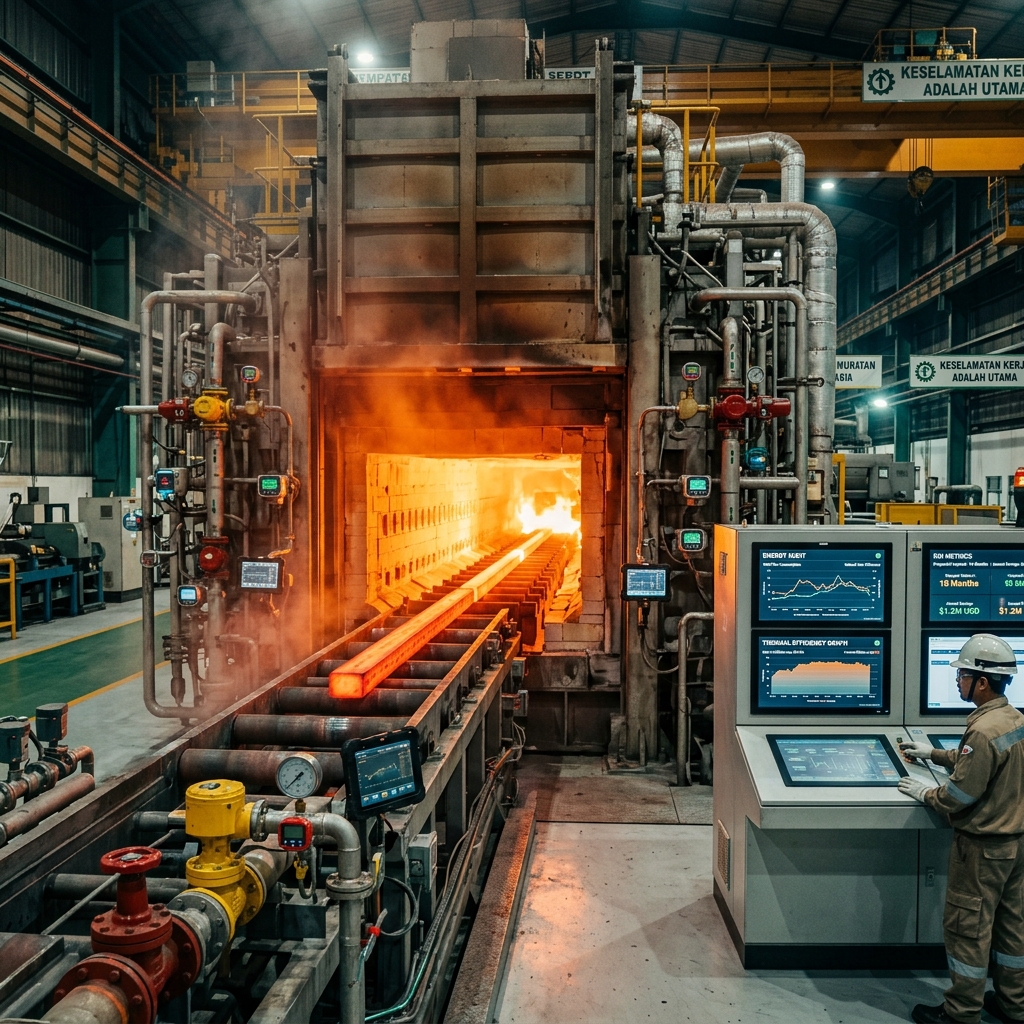
The Indonesian steel industry is undergoing a period of profound restructuring. Driven by the Ministry of Industry’s (Kementerian Perindustrian or Kemenperin) push for Green Industry Standards (Standar Industri Hijau or SIH) and Ministry of Energy and Mineral Resources (Kementerian ESDM) quota mandates, rolling mills across Java, Sumatra, and Sulawesi are under pressure to audit and modernize thermal operations. In a typical steel rolling mill, the reheating furnace is the single largest energy consumer, accounting for 60% to 70% of total natural gas consumption.
For hot rolling mills in Indonesia's primary steel clusters—including Cilegon (Banten), Surabaya and Gresik (East Java), and the industrial corridors of West Java—conducting a rigorous reheating furnace audit in Indonesia is no longer just a compliance exercise. With natural gas quotas tightly regulated under the Harga Gas Bumi Tertentu (HGBT) scheme and regional competition intensifying, thermal efficiency directly dictates whether a rolling mill operates at a profit or a penalty-laden loss.
This engineering guide provides a technical roadmap covering reheating furnace fundamentals, capacity calculation methods, Indonesian audit requirements from historical regulations (2018–2024) to 2026 mandates, and how mills can achieve a 10% to 15% fuel reduction with zero capital expenditure.
Regional Strategy: How does Indonesia's steel energy transition compare to other ASEAN markets like Vietnam? Read our regional roadmap: ASEAN Steel Energy Efficiency: Vietnam & Indonesia Reheating Furnace Roadmap →
1. What is a Reheating Furnace & What is Its Purpose in a Steel Mill?
Before diving into audit protocols, plant managers and operational engineers must understand the core thermodynamics and mechanical purpose of the reheating furnace within the rolling line.
What is a Reheating Furnace?
A reheating furnace is a continuous or semi-continuous industrial furnace utilized in hot rolling mills to elevate solid semi-finished steel stock—such as continuously cast billets, blooms, beam blanks, or slabs—from ambient temperature (or hot-charging temperatures of 500°C to 700°C) to the plastic deformation range, typically 1,150°C to 1,250°C.
Thermally, the furnace consists of three distinct functional chambers:
- Preheating Zone: Utilizes counter-flowing convective heat from hot exhaust gases to raise billet temperature to ~700°C without consuming direct burner fuel.
- Heating Zone: Operates at peak burner intensity (1,250°C–1,320°C chamber temperature) transferring radiant heat to the steel stock.
- Soaking Zone: Operates under gentle, uniform radiant heat (1,180°C–1,220°C) allowing core-to-surface temperature equilibration across the billet cross-section.
What is the Purpose of a Reheat Furnace in a Steel Mill?
The primary purpose of a reheat furnace in a steel mill is threefold:
- Lowering Flow Stress & Yield Strength: Steel at 1,200°C requires less than 15% of the mechanical rolling force needed at ambient temperatures, reducing the electric motor power consumption of roughing and intermediate stands and extending rolling roll lifespan. For a holistic plant-wide analysis, see our Hot Rolling Mill Energy Efficiency Guide.
- Ensuring Metallurgical Ductility: Proper thermal soaking dissolves carbide precipitates and equalizes internal core-to-surface grain structures, preventing surface tears, edge cracking, or cobbles during high-speed rolling of rebar, wire rod, or structural shapes.
- Minimizing Surface Oxidation (Scale Loss): A well-regulated furnace protects the steel surface from severe oxidation, ensuring minimal loss of saleable steel yield.
2. What Are the Different Types of Reheating Furnaces & How to Calculate Capacity?
Reheating furnaces are categorized primarily by how steel stock is conveyed through the thermal chamber. Each type presents unique thermodynamic characteristics and energy-saving opportunities during an audit.
Types of Reheating Furnaces
- Walking Beam Reheating Furnace: Billets rest on stationary refractory hearths and are periodically lifted and advanced by hydraulic walking beams. This eliminates skid mark chill spots and surface scratches, making it the preferred choice for modern rolling lines in Cilegon and Surabaya.
- Pusher-Type Reheating Furnace: Billets are pushed end-to-end over water-cooled skid pipes. While mechanically simple, pusher furnaces suffer from severe skid mark chill spots, high water-cooling heat losses, and door air infiltration.
- Walking Hearth Furnace: Moving refractory blocks form part of the hearth floor itself without water-cooled skid pipes, eliminating bottom skid marks for thick slabs or blooms.
- Rotary Hearth Furnace: A rotating circular hearth carries billets from charge door to discharge door, primarily used for seamless pipe plants and forging rounds.
| Furnace Type | Conveyance Mechanism | Skid Mark Formation | Thermal Efficiency | Suitability for Retrofit & Auditing |
|---|---|---|---|---|
| Walking Beam | Moving hydraulic refractory beams | Negligible / None | Highest (45% – 58%) | Excellent for recuperator & AI zone control retrofits |
| Pusher Type | Hydraulic pusher ram over skid pipes | Severe along water skids | Moderate (32% – 42%) | Prime target for skid insulation and WHR upgrades |
| Walking Hearth | Stepped moving refractory hearth | None | High (40% – 50%) | Good for burner staging and air-fuel ratio automation |
| Rotary Hearth | Rotating circular hearth floor | None | Moderate-High (38% – 48%) | Ideal for oxygen trim and pressure control |
How to Calculate Reheating Furnace Capacity?
Nominal furnace throughput capacity (C, in metric tonnes per hour, t/h) is determined by effective hearth surface area and specific hearth loading rate:
Capacity (t/h) = [Effective Hearth Area (m²) × Specific Hearth Loading Rate (kg/m²·h)] / 1,000
Where:
- Effective Hearth Area (m²): Internal Furnace Width (m) × Effective Heated Length (m).
- Specific Hearth Loading Rate (kg/m²·h): 350–480 kg/(m²·h) for top-fired pusher furnaces; 480–580 kg/(m²·h) for top-and-bottom fired pusher furnaces; and 580–750 kg/(m²·h) for modern walking beam furnaces.
- Total Thermal Input Capacity:
Q_total = Capacity (t/h) × Specific Fuel Consumption (SFC, kcal/tonne). For example, a 60 t/h furnace at 380,000 kcal/t requires60 × 380,000 = 22,800,000 kcal/h(~26.5 MW) burner firing capacity.
During our on-site audit, we contrast rated design capacity against actual operational capacity across different steel billet dimensions (e.g., 130 × 130 mm vs. 150 × 150 mm) to reveal bottlenecks in burner heat transfer and draft balance.
3. Reheating Furnace Audit in Indonesia: Regulatory Requirements (2018–2024 to 2026)
Indonesian industrial energy regulations have evolved rapidly over the past decade. Operating a steel reheating furnace without verified energy telemetry exposes mills to regulatory sanctions and severe gas price penalties.
Regulatory Evolution: Indonesia Furnace Audit Mandates (2018–2026)
- 2018 (MEMR / ESDM Regulation No. 12/2018): Introduced mandatory energy management protocols for industrial facilities consuming ≥ 6,000 TOE (tonnes of oil equivalent). Mills were required to designate a certified Energy Manager and conduct internal energy audits.
- 2022 (Government Regulation PP No. 33/2022 & ESDM 14/2022): Expanded energy conservation requirements, tightening reporting standards and empowering inspectors to verify industrial thermal balance logs.
- 2023–2024 (HGBT Quota Realignment - ESDM Decrees): Subsidized natural gas pricing under Harga Gas Bumi Tertentu (USD 6.00 to 7.00 per MMBTU) was formally tied to strict monthly quota allocations. Under ministerial adjustments across 2023 and 2024, consumption exceeding allocated quotas is invoiced at market rates (USD 9.50 to 12.00 per MMBTU)—instantly penalizing inefficient rolling mills with 50% to 70% cost surcharges.
- 2026 (Kemenperin Standar Industri Hijau - SIH Compliance): Enforces mandatory Specific Fuel Consumption (SFC) caps per tonne of rolled steel, requiring verified carbon accounting, continuous flue gas emissions control, and waste heat recovery systems.
Core Technical Requirements for an Indonesian Furnace Audit
To satisfy ESDM inspectors and Kemenperin SIH auditors, an industrial furnace audit must document:
- Calibrated Specific Fuel Consumption (SFC): Gas consumption (in Nm³ or MMBTU) per metric tonne of heated steel across variable rolling speeds.
- Flue Gas Stack Diagnostics: Continuous measurement of exit temperature, excess oxygen (O₂), carbon monoxide (CO), and NOₓ levels.
- Refractory Shell Loss Mapping: Infrared thermographic scans of furnace walls, roof, hearth, and discharge doors to identify insulation degradation.
- Recuperator Heat Balance: Preheated combustion air temperature vs. flue gas inlet/outlet enthalpy balance.
- Billet Discharge Temperature Uniformity: Verification that billets achieve ±15°C core-to-surface temperature uniformity before entering the roughing mill.
Download Indonesia Reheating Furnace Audit Checklist (PDF)
Are you preparing for an ESDM thermal verification or Kemenperin SIH Green Industry audit? Download our standardized Reheating Furnace Audit in Indonesia Checklist (PDF) covering combustion air pressures, recuperator delta-T limits, and HGBT gas quota tracking formulas.
Request On-Site Furnace Audit in Cilegon / Surabaya (Indonesia)
Our thermal combustion specialists provide direct on-site mobilization to steel rolling mills across the Cilegon (Banten) and Surabaya / Gresik (East Java) industrial corridors. Conduct thermodynamic baseline audits with zero rolling line downtime under CISA T80 standards.
4. On-Site Audit Methodology & Key Thermal Losses
You cannot manage what you do not measure. In many Indonesian steel mills, operators lack detailed data on their reheating furnace's actual thermodynamic performance. They monitor total gas intake and overall steel output, but the internal efficiency of individual heating zones remains an unmeasured "black box."
A professional energy audit begins by mapping the furnace's heat balance. Using high-precision portable flue gas analyzers, thermal imaging cameras, and ultrasonic flow meters, engineers measure fuel gas velocity, combustion air flow, shell heat dissipation, and flue gas temperature. This data establishes the thermodynamic Specific Fuel Consumption (SFC) curve against varying production rates.
- Case Results in Cilegon, Banten: An energy audit conducted on a 60-tonne-per-hour pusher-type reheating furnace in Cilegon, Banten, revealed that the furnace was operating at an average thermal efficiency of just 42%. Flue gas was escaping at 810°C, and excess oxygen in the heating zone was measured at 6.8%. This excess air was carrying away an estimated 13.5% of the fuel's total chemical energy straight out of the stack.
Before scheduling your on-site audit, calculate your baseline thermal balance and estimate potential natural gas savings with our free calculators:
5. High-ROI Optimization: Waste Heat Recuperators & AI Combustion
To eliminate the heat losses identified during the audit, steel rolling mills implement two primary high-impact engineering retrofits:
Waste Heat Recovery (WHR) via Multi-Pass Recuperators
A high-efficiency waste heat recovery upgrade replaces degraded heat exchangers with modern, multi-pass metallic recuperators. These systems route incoming combustion air through high-temperature alloy tubes surrounded by hot flue gases, preheating combustion air to 400°C–450°C. For every 100°C increase in combustion air preheat, fuel consumption drops by approximately 5%.
- Case Results in West Java: A structural steel rolling mill in West Java replaced a cracked single-pass recuperator with a double-pass metallic recuperator designed to T80 standards. Combustion air preheat rose from an unstable 180°C to a consistent 420°C, delivering a verified 11.5% reduction in natural gas consumption per tonne of steel rolled.
AI-Driven Stoichiometric Combustion Control
AI-driven combustion control installs zirconium oxide (ZrO₂) oxygen sensors in the flue duct of each heating zone. A predictive algorithm micro-adjusts air and gas valves in real-time, keeping excess oxygen levels tightly controlled between 1.5% and 2.0% across all zones.
- Case Results in Jakarta Industrial Corridor: A rebar mill in the Jakarta area integrated zone-by-zone combustion control with zirconium oxide sensor feedback. Excess oxygen was maintained below 2.0% during steady-state operations, reducing scale loss from 1.65% to 1.15% and saving approximately 5 tonnes of steel yield per day ($3,200/day in additional product revenue).
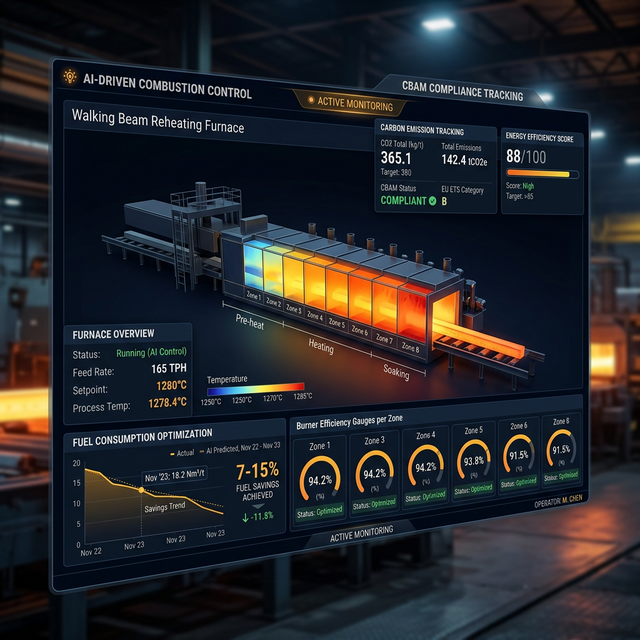
Figure 1: AI-driven smart combustion control dashboard displaying zone-by-zone burner parameters and gas consumption trends.
6. ROI Analysis: The Zero CAPEX Energy Steward Model
Implementing deep thermal upgrades—including recuperators, PLC instrumentation, and zone control valves—typically requires an upfront capital investment of USD 250,000 to USD 400,000 per furnace. For many Indonesian steel mills, allocating this level of CAPEX is difficult.
The Energy Steward Model (a performance-based contracting model) resolves this barrier. South Technology designs, procures, installs, and maintains all optimization equipment at zero upfront cost to the steel mill. Energy savings are measured monthly using the International Performance Measurement and Verification Protocol (IPMVP). The steel mill pays only a percentage (typically 50% to 60%) of verified fuel savings. If no savings are achieved, the mill pays nothing.
- Case Results in Cilegon, Banten: A structural steel mill in Cilegon partnered with South Technology under the Energy Steward Model to retrofit its walking beam reheating furnace. South Technology invested USD 320,000 in a double-pass recuperator and AI combustion control. The project achieved a verified fuel consumption reduction of 11.8%. The resulting natural gas savings generated USD 42,000 in monthly cost reductions. The mill retained USD 18,900 of these savings monthly, improving its cash flow from day one without any capital expenditure.
- Case Results in Surabaya, East Java: By implementing automated combustion zones and integrating predictive holding controls, a hot rolling mill in Surabaya, East Java, reduced its average monthly natural gas consumption by 9.2%. This efficiency gain allowed the mill to operate entirely within its HGBT allocation, saving an estimated USD 145,000 annually in market-rate gas penalties.
Geopolitical Compliance & Risk Mitigation Disclaimer
The information presented in this article regarding Indonesia’s Harga Gas Bumi Tertentu (HGBT) policy and Kemenperin’s Standar Industri Hijau (SIH) is compiled from public regulatory announcements for educational and informational purposes. While the thermal optimization technologies described have historically achieved fuel savings between 7% and 15% across global installations, actual energy savings, emissions reductions, and policy compliance outcomes are site-specific. Performance depends on the furnace’s physical condition, baseline operating practices, steel grades rolled, and local gas quality. EcoReheating does not guarantee fixed fuel reduction percentages, specific financial returns, or automatic regulatory compliance certification.
See how much you could save using our Energy Steward Model
Based on typical 11% fuel efficiency optimization.
Get Verified ROI AuditFrequently Asked Questions
Q.What is a reheating furnace?
A reheating furnace is an industrial thermal processing unit used in hot rolling mills to heat solid semi-finished steel products—such as continuous cast billets, blooms, or slabs—from ambient temperature or hot-charging temperatures (500°C–700°C) up to plastic deformation temperature (typically 1,150°C to 1,250°C) suitable for rolling into rebar, wire rod, sections, or flat steel.
Q.What is the purpose of a reheat furnace in a steel mill?
The primary purpose of a reheat furnace in a steel mill is to soften solid steel stock by reducing its yield strength and increasing material ductility, allowing rolling mill stands to deform the steel with minimal mechanical power and rolling roll wear. It must heat the steel uniformly along its length and cross-section while minimizing metallurgical defects such as surface scale loss (oxidation) and decarburization.
Q.What are the different types of reheating furnaces?
The four primary types of industrial reheating furnaces are: 1) Walking Beam Furnaces, which offer the highest thermal efficiency, zero skid mark defects, and flexible billet handling; 2) Pusher-Type Furnaces, a legacy workhorse where billets are pushed along water-cooled skids; 3) Walking Hearth Furnaces, used where bottom skid marks must be eliminated for thick stock; and 4) Rotary Hearth Furnaces, circular rotating furnaces primarily used for pipe, tube, and forging rounds.
Q.How to calculate reheating furnace capacity?
Reheating furnace capacity (in tonnes per hour, t/h) is calculated using the effective hearth area multiplied by the specific hearth loading rate divided by 1,000: Capacity (t/h) = [Effective Hearth Area (m²) × Specific Hearth Loading (kg/m²·h)] / 1,000. Typical specific hearth loading values range from 350 to 500 kg/(m²·h) for top-fired pusher furnaces, and between 550 to 750 kg/(m²·h) for modern top-and-bottom fired walking beam furnaces.
Q.What are the regulatory requirements for a reheating furnace audit in Indonesia?
Under MEMR/ESDM Regulations (No. 12/2018 and PP No. 33/2022) and Kemenperin Green Industry Standards (SIH), industrial facilities consuming over 4,000–6,000 TOE per year must conduct periodic certified thermal energy audits. Key requirements include establishing a verified Specific Fuel Consumption (SFC) baseline, continuous flue gas analysis (O₂, CO, NOx), metering natural gas under HGBT quotas, and documenting stack waste heat recovery efficiency.
Q.Why is a professional thermal audit necessary before implementing furnace optimization?
A professional thermal audit establishes a baseline for Specific Fuel Consumption (SFC) against varying production rates. Without this baseline, it is impossible to calculate actual fuel savings, measure ROI, or structure a performance-based contract. Additionally, audits identify specific areas of heat loss and oxygen levels, allowing engineers to custom-size recuperators and burner control zones.
Q.How does furnace automation help steel mills stay within their monthly HGBT gas quotas?
Indonesian steel mills under the HGBT policy receive subsidized gas at USD 6.00 to 7.00/MMBTU but are subject to strict monthly allocation limits. Consumption above this quota is priced at premium market rates (USD 9.50 to 12.00/MMBTU), increasing costs by up to 70%. Upgrading furnace automation introduces predictive holding modes that automatically throttle burners during mill delays, reducing overall gas usage by 8-10% and ensuring the mill stays within its quota limits.
Q.What is the typical repayment structure for a Zero CAPEX furnace upgrade?
Under the Energy Steward Model, the technology provider funds 100% of the engineering, hardware, and installation costs. The steel mill pays nothing upfront. Repayment is structured as a monthly share of verified fuel cost savings (measured against the pre-project baseline). If no savings are achieved in a given month, the payment is zero, eliminating financial risk for the operator.
Li Minghua
Project Director, South Technology
Li Minghua is a Project Director at South Technology with over 15 years of experience in thermal audits, furnace retrofits, and Zero-CAPEX performance-based contract management across Southeast Asia.