Rolling Mill Energy Efficiency: Hot Rolling Optimization Guide (2026)
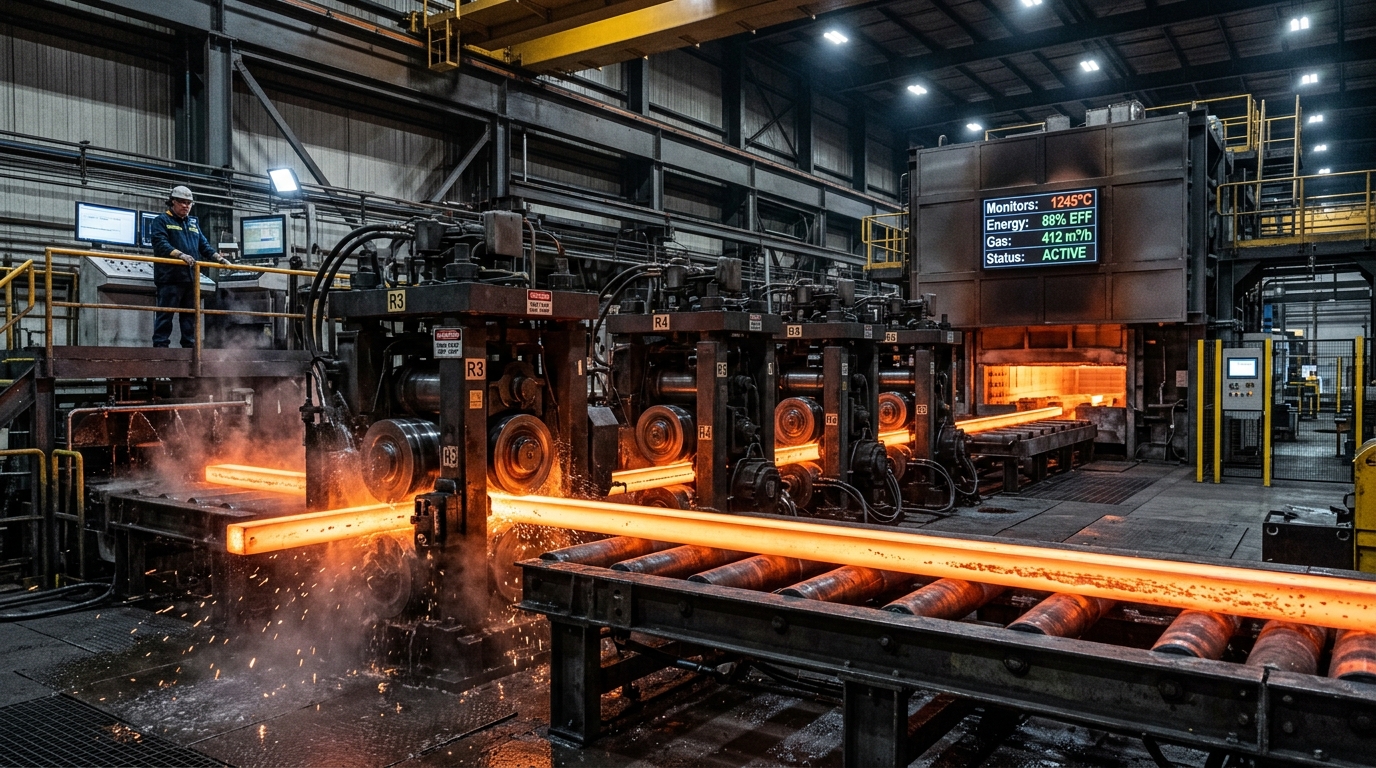
In modern industrial metalworking, few manufacturing operations consume as much concentrated thermal and electrical power as a steel hot rolling mill. With utility rates soaring globally and international carbon regulations like the EU's Carbon Border Adjustment Mechanism (CBAM) penalizing high-emission steel, plant directors and chief engineers face unrelenting pressure: maximize hot rolling mill energy efficiency or risk margin collapse.
A hot rolling mill is not a standalone machine—it is an interconnected thermodynamic and mechanical system. True energy optimization requires addressing the entire production sequence, from initial billet reheating to roughing passes, transfer tables, and high-speed finishing stands.
This engineering guide examines the core drivers of steel mill energy consumption and outlines 5 actionable engineering areas to reduce both fuel and electricity usage while improving overall rolling mill economy.
1. The Economics of Steel Mill Energy Consumption
To build an effective hot rolling mill energy efficiency model, engineering leadership must first benchmark where energy is spent.
Understanding the Hot Rolling Mill Energy Efficiency Ratio & Benchmarks
In long and flat steel rolling operations, energy performance is evaluated using the energy efficiency ratio (specific energy consumption per ton of prime product):
- World-Class Benchmark: 1.05 – 1.25 GJ/ton (approx. 280–330 Mcal/ton thermal + 65–85 kWh/ton electrical)
- Average Global Plant: 1.35 – 1.65 GJ/ton
- Inefficient Legacy Mill: > 1.80 GJ/ton
Regional Benchmarks: Rolling Mill Energy Efficiency in China, India, and Global Plants
Specific energy consumption varies significantly across geographical steelmaking hubs due to furnace design and regulatory standards:
- Rolling Mill Energy Efficiency in China: Driven by mandatory CISA (China Iron & Steel Association) benchmark standards and ultra-low emission retrofits, tier-1 Chinese mills operate walking beam furnaces at benchmark levels of 1.10 – 1.25 GJ/t (approx. 28 – 32 Nm³ natural gas/t).
- Rolling Mill Energy Efficiency in India & Southeast Asia: Many secondary re-rolling mills (mills without continuous casting) and legacy pusher setups operate between 1.60 – 2.10 GJ/t. Upgrading combustion systems and furnace insulation under market schemes like BEE/PAT delivers rapid fuel reductions of 12% to 20%.
- North America & Europe: Heavy focus on electrification, CBAM carbon accounting, and high-efficiency AC stand drives with heat retention enclosures.
Fuel vs. Power: Where Mill Energy Usage is Concentrated
Total mill energy consumption breaks down into two distinct categories:
- Thermal Fuel Consumption (70% – 80% of total energy): Consumed almost entirely in the walking beam reheating furnace to heat cold or warm billets from ambient up to the plastic deformation range (1,150°C – 1,250°C).
- Electrical Power Consumption (20% – 30% of total energy): Utilized by high-pressure hydraulic descaling pumps, roughing stand main drives, finishing block motors, run-out table laminar cooling pumps, and coilers.
Total Mill Energy: [■■■■■■■■ Reheating Furnace Fuel: 75% ] [■■ Electrical Drives & Pumps: 25% ]
2. Area 1: Reheating Furnace Modernization (The 75% Fuel Sink)
Because the reheating furnace represents three-quarters of total mill energy usage, it is the highest-leverage target in any steel rolling energy efficiency program. For dedicated combustion parameters and insulation benchmarks, consult our comprehensive Reheating Furnace Fuel Savings Guide.
Upgrading to Walking Beam Furnace Geometry
Many legacy rolling mills across Asia and Latin America still operate pusher-type furnaces. Pusher furnaces suffer from severe limitations:
- Water-cooled skid pipes cause deep billet cold spots ("skid marks"), forcing operators to overheat the entire furnace by 30°C to 50°C to compensate.
- Billets rub against hearth refractories, generating operational downtime and surface defects.
Replacing or retrofitting pusher mechanisms with a modern walking beam reheating furnace eliminates skid contact, guarantees uniform 360-degree heat absorption, and reduces specific fuel consumption by 10% to 18%. Engineers can benchmark potential thermal savings using the Reheating Furnace Heat Balance Calculator.
High-Emissivity Refractories & Low-Inertia Fiber Roofs
Traditional heavy refractory brick roofs absorb immense heat energy during startup and radiate heat outward through structural furnace steelwork. Upgrading to CISA T80-listed all-ceramic fiber modular roofs cuts roof weight by 90% and slashes standby thermal losses.
Simultaneously, applying nano-ceramic high-emissivity coatings onto furnace sidewalls increases radiative heat flux back onto billet surfaces, enabling faster heating ramp-ups with reduced burner firing rates.
Closed-Loop AI Combustion Control
Fluctuating gas calorific values and ambient draft changes lead to excess oxygen in the furnace atmosphere, driving up gas usage and increasing oxidation scale formation. Implementing AI-driven dynamic combustion control keeps the air-fuel equivalence ratio within a tight stoichiometric window, saving 3% to 6% in fuel while preventing product scale loss.
Mitigating Oxidation Scale Loss (氧化烧损) & Maximizing Billet Yield
In steel hot rolling mills, thermal efficiency and material yield are intrinsically linked. High furnace temperatures (>1,150°C), excess free oxygen in the combustion chamber, and extended residence times cause surface steel to oxidize into iron oxides (FeO, Fe₃O₄, Fe₂O₃), resulting in severe oxidation scale loss:
- The Economic Toll: Typical unoptimized mills lose 1.5% to 2.5% of total steel throughput to oxidation scale. On a 1,000,000-tonne-per-year hot rolling line, reducing scale loss by just 0.5% preserves 5,000 tonnes of prime billet steel annually—delivering over $3,000,000 USD in direct recovered margin.
- Low-Oxygen Soaking Atmosphere: By deploying precision continuous ZrO₂ flue oxygen sensors and modulating burner air-fuel ratios in the soaking zone down to stoichiometric equilibrium (< 1.5% excess O₂), the rate of oxidation is suppressed by up to 35%.
- Dual Benefit for Descaling & Roll Wear: Thinner, uniform primary scale requires lower hydraulic descaling pressure, reducing descaling motor electricity and minimizing abrasive mechanical wear on roughing and intermediate rolls.
Mill Pacing & Billet Extraction Rhythm (轧机节奏与炉机协同)
One of the largest hidden drivers of energy waste in hot rolling mills is the synchronization disconnect between the reheating furnace and the rolling line:
- The Delay Penalty: When micro-stoppages occur downstream (such as sizing changes, inter-stand cobbles, or guide adjustments), billets sit stationary in the high-heat soaking zone. Prolonged holding causes specific fuel consumption (SFC) to spike and creates deep surface decarburization and excessive scale buildup.
- Dynamic Mill Pacing Automation: Modern hot rolling mill energy efficiency architectures deploy closed-loop mill pacing algorithms. The automation system continuously monitors roll stand cycle times, bar travel velocities, and rougher entry schedules, dynamically commanding the walking beam extraction mechanism.
- Automated Delay Holding Modes: If mill rhythm telemetry indicates a delay exceeding 180 seconds, the furnace control system automatically ramps down burner firing in the preheat and heating zones while throttling stack dampers. This maintains core billet temperature at rolling threshold without burning excess fuel or over-scaling billet surfaces.
3. Area 2: High-Pressure Hydraulic Descaling Power Optimization
Before entering the roughing stands, reheated steel passes through high-pressure water descaling headers (typically operating at 160 to 250 bar) to remove secondary scale. Descaling systems represent one of the largest electrical power draws on the mill floor.
Variable Frequency Drives (VFD) on Descaling Pumps
In conventional mills, multi-stage centrifugal descaling pumps run continuously at full speed, dumping high-pressure water back to the sump via bypass valves during inter-billet gaps.
- Installing high-response Variable Frequency Drives (VFDs) or hydraulic accumulator auto-unloading controls reduces idle electrical consumption by 25% to 40%.
Spray Nozzle Header Geometry & Thermal Preservation
Excessive descaling water volume or misaligned spray angles cools the billet surface excessively (often dropping surface temperature by 40°C to 70°C). When billets cool excessively during descaling, the rolling mill requires significantly higher mechanical deformation torque, driving up mill motor power. Precision spray nozzle design ensures complete scale removal with minimal water volume, preserving core billet enthalpy.
4. Area 3: Transfer Bar Thermal Retention Between Roughing and Finishing
In flat strip mills and long product roughing lines, intermediate bars travel across open roller tables between the roughing stand and the finishing mill train. During this transfer, radiation and convection heat losses can cause bar temperature to drop by 60°C to 120°C.
Heat Retention Panels (Thermal Enclosures)
Installing passive insulated heat retention covers over the intermediate transfer roller table traps radiant heat, keeping the bar's tail end at rolling temperature.
[Roughing Mill] ──> [Insulated Heat Retention Tunnel] ──> [Finishing Stands]
                      ▲ Minimizes bar heat loss by 50-70°C
The Energy Impact on Finishing Stands
Every 20°C of temperature preserved in the transfer bar translates directly to:
- 8% to 12% lower rolling resistance during finishing passes.
- Measurable drops in finishing stand main drive electric amperage, directly boosting overall steel hot rolling energy efficiency.
- Reduced risk of head-to-tail metallurgical inconsistency, eliminating out-of-spec cobbles.
5. Area 4: Finishing Stand Rolling Power & Motor Efficiency
The fundamentals of rolling energy metalworking calculations dictate that electrical work done by stand motors equals the product of metal flow stress, roll contact arc, and reduction draft. Understanding the vital steel rolling energy efficiency role played by finishing stands is essential for peak electrical load management.
Optimizing Draft Schedules to Reduce Peak Motor Load
Uneven reduction schedules across multi-stand finishing trains often overload intermediate motor drives while leaving outer stands under-utilized.
- By re-optimizing the roll pass schedule using computerized roll pass design software, motor loading is balanced across all stands.
- Eliminating motor current spikes prevents peak-demand electrical tariff penalties and lowers total kWh consumed per rolled ton.
Modernization to High-Efficiency AC Drives & Roll Bearings
Older direct current (DC) motors and plain oil-film bearings waste substantial electrical power through internal electrical and friction losses:
- Upgrading to premium efficiency permanent magnet synchronous AC motors reduces electrical transmission losses by 3% to 5%.
- Employing synthetic rolling mill lubricants and sealed multi-row tapered roller bearings reduces rotational friction, yielding a lower hot rolling mill energy efficiency rating footprint.
High-Speed Steel (HSS) Rolls & 4-High Mill Friction Reduction
Mechanical friction within the roll bite directly governs electrical drive power:
- Electrical Energy Consumption with HSS Rolls: Upgrading from conventional high-chromium cast iron rolls to High-Speed Steel (HSS) work rolls in pre-finishing and finishing stands cuts the roll-strip friction coefficient by 15% to 20%. This measurably lowers electrical energy consumption with HSS rolls by 3% to 6% per rolled ton while extending roll campaign wear life up to 300%.
- Rigidity of Modern 4-High Rolling Mills: In flat product and hot strip mills, deploying rigid 4-high stand configurations (where large backup rolls support slender work rolls) minimizes elastic roll deflection. This enables heavier, more uniform reduction passes with lower motor current spikes compared to less rigid legacy stands.
6. Area 5: How to Improve Rolling Mill Efficiency with Zero-CAPEX Retrofitting
Achieving top-tier steel hot rolling energy efficiency requires uniting separate mill subsystems into an enterprise-wide energy efficiency program. Plant engineers asking how to improve rolling mill efficiency across aging infrastructure can benchmark target gains across all four operational tiers:
Rolling Mill Energy Benchmarking Framework
| Process Subsystem | Baseline Share | Primary Inefficiency Root Cause | Target Improvement Solution | Typical Energy Savings |
|---|---|---|---|---|
| Reheating Furnace | 70% – 80% | High flue exit loss, uninsulated skid pipes, manual burner firing | Walking beam retrofit, fiber roof, AI combustion control | 7% – 15% Fuel |
| Descaling System | 8% – 12% | Continuous full-speed pump operation, nozzle over-spraying | VFD pump controls, low-flow high-impact spray headers | 20% – 35% Power |
| Transfer Tables | 3% – 5% | Radiation cooling to ambient air during transfer | Insulated heat retention covers & edge shields | 40–60°C Enthalpy |
| Rolling Stands | 10% – 15% | Sub-optimal roll draft schedules, legacy DC motor losses | Pass schedule re-balancing, high-efficiency AC motors | 5% – 10% Power |
Overcoming Capital Constraints: The Zero-CAPEX Energy Steward Model
The primary obstacle preventing steel mills from implementing these modernization steps is capital expenditure (CapEx) competition. Capital budgets are frequently earmarked for capacity expansion or emergency maintenance, leaving thermal efficiency projects unfunded.
To break this bottleneck, leading industrial facilities utilize the Zero CAPEX Model:
- $0 Upfront Investment: South Technology and our clean-energy financial partners fund 100% of the engineering, CISA T80 refractory materials, AI controls, and installation.
- Guaranteed Performance: Equipment performance is verified against calibrated baseline meters. If fuel consumption does not decrease, the mill pays zero.
- Turnkey Execution: Hardware modules are pre-assembled offsite, limiting physical installation to a standard 2-to-4 day maintenance shutdown.
- Immediate Positive Cash Flow: The client pays for the project strictly out of a percentage share of verified monthly fuel savings.
Explore our comprehensive technical upgrades on our Furnace Efficiency Upgrades engineering hub, or review real-world natural gas reduction figures in our field audit report on Reheating Furnace Audit in Indonesia for Steel Rolling Mills.
Conclusion: Transform Your Rolling Mill Economics
In 2026 and beyond, energy efficiency is no longer an optional sustainability metric—it is the decisive factor governing rolling mill economy and plant profitability. By taking a holistic approach across the reheating furnace, descaling headers, transfer tables, and finishing stands, steel producers can reduce fuel consumption by 7–15% and cut electrical usage by 10–20%.
With zero-CAPEX financing options available, there is no financial reason to continue burning unnecessary fuel.
Rolling Mill Energy Audit
Audit Your Mill's Specific Fuel & Power Potential
Our chief metallurgical engineers will benchmark your mill's fuel-to-steel ratio against CISA T80 best practices and deliver a customized thermal balance report.
Comprehensive Heat Balance
Zero-CAPEX Feasibility
Available for Long & Flat Rolling Lines
See how much you could save using our Energy Steward Model
Based on typical 11% fuel efficiency optimization.
Get Verified ROI AuditFrequently Asked Questions
Q.How much electricity does a steel mill use during hot rolling?
In a steel hot rolling mill, electrical power accounts for 20% to 30% of total mill energy consumption (typically 65 to 110 kWh per ton of rolled steel). Main electrical consumers include high-pressure hydraulic descaling pumps (8-12%), roughing and finishing stand main drive motors (10-15%), and auxiliary run-out tables. The remaining 70% to 80% is thermal fuel consumed by the billet reheating furnace.
Q.What is the typical hot rolling mill energy efficiency ratio?
In modern steel plants, the overall hot rolling mill energy efficiency ratio typically ranges between 1.1 to 1.6 GJ per ton of finished rolled steel. The primary thermal sink is the reheating furnace (accounting for 70-80% of mill energy consumption), while electrical main drives, descaling pumps, and auxiliary systems consume 70-110 kWh/ton.
Q.How much does a rolling mill energy efficiency retrofit cost?
Traditional capital expenditure for rolling mill revamps can range from $500,000 to over $3,000,000 USD. However, under the Zero-CAPEX Energy Steward Model (Contract Energy Management), the technology provider finances 100% of engineering, refractory upgrades, and AI combustion automation. The steel plant pays zero upfront capital and repays solely through a share of verified monthly fuel savings.
Q.How much of total steel mill energy consumption comes from the hot rolling mill?
In an integrated or mini-mill steel manufacturing route, the hot rolling mill accounts for approximately 10% to 15% of total plant-wide steel mill energy consumption, and up to 60-70% of total non-smelting fuel and electricity usage. Modernizing the mill yields immediate bottom-line reductions in operating costs.
Q.What is the most effective single measure to cut fuel usage in steel hot rolling?
Upgrading the reheating furnace from legacy pusher-type technology to a modern walking beam reheating furnace equipped with closed-loop AI combustion control and CISA T80-certified low-inertia refractory fiber roofs. This single intervention reliably cuts furnace fuel consumption by 7% to 15%.
Q.How does an industrial rolling mill energy efficiency program improve rolling mill economy?
A comprehensive rolling mill energy efficiency program integrates furnace temperature optimization, transfer bar heat retention covers, and variable frequency descaling. Beyond reducing utility bills, it cuts scale loss by 0.2-0.4%, improves billet surface quality, extends roll life, and lowers CBAM carbon tax penalties.
Dr. Aris Thorne
Senior Metallurgical Consultant, EcoReheating
Dr. Aris Thorne has spent over 22 years optimizing rolling mill thermodynamics and industrial combustion across North America, Europe, and Southeast Asia.